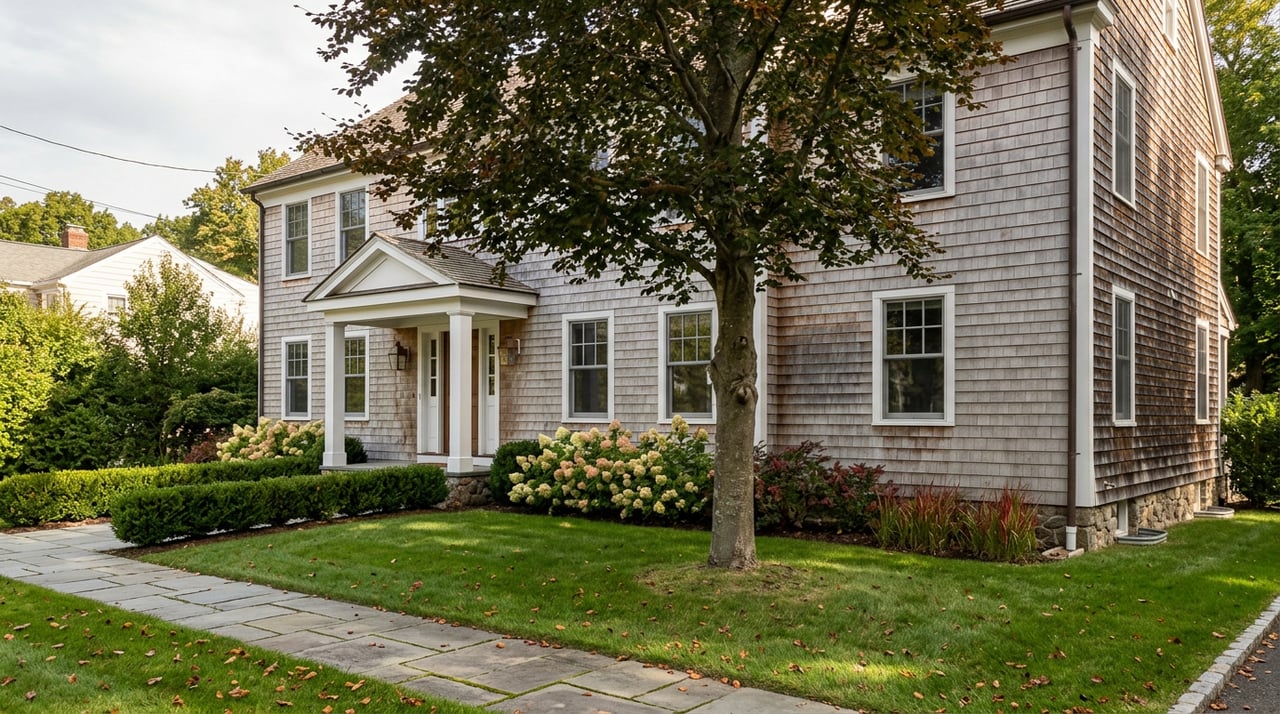
If you buy an older home in Newburyport planning to tear it down and start fresh, how long could the city make you wait before you're allowed to touch it?
Most people guess wrong in both directions. Some assume "historic district" means the city controls their paint color and window trim, so they brace for a fight over things that barely matter. Others assume a demolition permit is a formality once the structure is condemned or simply unwanted, so they underprice the holding costs. Neither instinct matches how Newburyport actually regulates older buildings, and the gap between the two shows up right now in a live case on Merrimac Street and a City Council vote that just changed the math for anyone circling an older lot.
The case that shows what's actually at stake
At 568 Merrimac Street, a one-story ranch house is proposed to be replaced with a much larger home, with more bedrooms and more bathrooms, under a Zoning Board of Appeals docket numbered ZNC-26-1. The record shows no public comments in opposition. That single fact tells you something the historic district conversation usually skips: most teardown and rebuild projects in Newburyport aren't controversial, and most don't get stopped. What they get is delayed, and the delay just got longer.
Three systems share one name, and only one of them touches your paint color
Newburyport property owners tend to lump every historic protection into a single mental category: "the historic district." In practice there are three separate mechanisms, and they don't do the same job.
The Newburyport Historic District on the National Register of Historic Places covers a large swath of the city, one of the largest National Register districts in Massachusetts, and it is mostly an honorary designation. Listing on the National Register offers limited protection from state or federally funded projects and opens the door to certain tax credits, but it does not give a commission the power to approve or deny your window replacement or your paint color. According to the Massachusetts Historical Commission, features like paint color, storm windows, and temporary structures are commonly exempt even where local review exists, and National Register status alone carries no binding review power over private renovation choices.
The Fruit Street Local Historic District is a different animal entirely. Established by City Council ordinance on October 29, 2007, it is Newburyport's only Local Historic District under Massachusetts General Laws Chapter 40C, and it is small: Fruit Street itself plus a handful of adjoining addresses on Prospect Street and High Street. Inside that specific footprint, the Fruit Street Historic District Commission reviews exterior changes visible from a public way and can require a Certificate of Appropriateness before work proceeds. That's the one place in the city where the fear most owners have, someone telling you what color to paint your trim, actually has legal teeth.
The Demolition Control Overlay District, or DCOD, is the third piece, and it's tied to how much of a building you're removing rather than to a district boundary. If a structure is listed as "Contributing" in the city's historic data sheets and a project would demolish more than 25 percent of its exterior walls, the Zoning Board of Appeals becomes the special permit authority, weighing an advisory report from the Newburyport Historical Commission alongside the rest of the application. Window replacement in an existing opening, without more, doesn't trigger this review at all.
The rule that just got longer
The mechanism that actually slows down a teardown, for most owners in most parts of the city, is the Demolition Delay Ordinance, first adopted in 2005 to give the city time to look for an alternative before a historically significant building comes down. On May 11, 2026, the Newburyport City Council voted 9-2 to advance an amended version of that ordinance, numbered Ordinance 217, extending the standard delay period from 12 months to 18 months for primary structures 75 years or older and accessory structures 100 years or older, where the Newburyport Historical Commission finds the building preferably preserved. That threshold isn't abstract. A primary structure has to be built before 1951 to qualify under the 75-year test as of this year, and an accessory structure before 1926 under the 100-year test.
The debate leading up to that vote is worth understanding because it shows how contested the current 12-month window already is. Preservation advocate Jared Eigerman, speaking for the Newburyport Preservation Trust, told the Council the existing delay "doesn't do anything," pointing to houses on Spofford Street that he said went to the landfill once the clock ran out. Rita Mihalek, of 53 Warren Street, argued even 18 months isn't enough, since a well-capitalized buyer can simply wait it out. Robin Ziegler, of 151 Merrimac Street, testified that she and her husband moved to Newburyport in 2023 largely because of the city's historic character, framing the vote as a question of whether that character survives the next decade of turnover. The amendment passed on first reading, not as finished law, so anyone weighing a purchase around an older structure should confirm current status before assuming the 18-month period applies.
What this actually changes for a transaction
If you are buying an older Newburyport home with a teardown or major-rebuild plan, the delay period is a carrying-cost problem before it's anything else. Under the current 12-month rule, a buyer who wants to demolish a 75-year-old structure needs the Historical Commission to complete review, and if delay is invoked, needs to hold the property for up to a year before proceeding, absent a negotiated release tied to specific replacement plans. If the extended 18-month period becomes final, that's six additional months of property taxes, insurance, and financing costs on a property you can't yet build on, which is real money on a North Shore lot regardless of your final construction budget.
The DCOD adds a second, separate layer in parts of the city where it applies. Ward 1 Councilor Sharif Zeid noted during the same debate that his ward already carries a high bar for demolition because of the overlay district, saying a project there essentially has to prove a structure has no remaining economic value. That means the actual friction a buyer faces depends heavily on which layer, or combination of layers, applies to a specific address, not on a single citywide rule.
What to check before you write an offer
A few concrete steps separate a buyer who understands their timeline from one who gets surprised by it.
- Pull the assessor's record for the structure's actual age. The 75-year and 100-year thresholds are hard cutoffs, not approximations.
- Ask whether the Newburyport Historical Commission has already reviewed the property or a similar one nearby, since a prior finding of "preferably preserved" signals how the Commission is likely to treat your project.
- Confirm whether the parcel sits inside the Demolition Control Overlay District, since that determines whether the Zoning Board of Appeals becomes a second reviewing body beyond the Historical Commission.
- Check whether the address falls inside the Fruit Street Local Historic District specifically, since that is the only place where routine exterior choices like paint and trim carry binding review.
- Verify the current status of Ordinance 217, since a first-reading vote is not final law and the delay period you plan around should match what's actually in effect at the time you close.
FAQ
Does the demolition delay ordinance stop interior renovation? No. The delay period applies to demolition as defined in the ordinance, which centers on exterior changes like roofline alterations, footprint changes, and full or partial teardown. Interior work generally proceeds under standard building permits.
Can I still replace windows without a hearing? In most of the city, yes. Window replacement in an existing opening, without additional structural work, does not trigger DCOD or Historical Commission review on its own. Inside the Fruit Street Local Historic District specifically, exterior changes visible from a public way do require review.
What if my house is 60 years old, not 75? The 75-year threshold is what currently triggers eligibility for demolition delay review. A house short of that age doesn't fall under this particular ordinance, though other permitting requirements still apply.
Does this apply outside Newburyport? This piece describes Newburyport's specific ordinances. Neighboring Essex County towns run separate demolition delay bylaws with their own thresholds and timelines, so a similar-looking older home in another town may face a different clock entirely.
Older homes carry real character and real friction in the same package, and the friction rarely shows up on a listing sheet. If you're weighing a purchase or a sale involving a Newburyport property with any age or renovation question attached, Douglas Danzey can help you find out which of these rules actually applies to your address before you're under contract. Schedule a call.